Treatment options
General dentistry
Research has shown that almost everybody has a 95% chance of experiencing some tooth decay. When tooth decay does occur, it is highly important to remove it, clean and repair the tooth with some type of restoration. In addition, lost or missing teeth need to be replaced to protect your overall oral health.
Composite fillings
Composite fillings are strong, but may not be as hard wearing as amalgam fillings. Composite fillings are tooth-coloured and are made from powdered glass quartz, silica or other ceramic particles added to a resin base. After the tooth is prepared, the filling is bonded onto the area and a light-shone onto it to set it. The dentist will choose a shade to match your existing teeth, although over time staining can happen.
Inlays and onlay
An inlay is small and within the biting surface of the tooth. An onlay can cover a larger area of the tooth. Gold is the most long-lasting and hard wearing filling material and will last for many years. An advantage of gold is that it does not tarnish and has great strength. One of the differences between gold and other filling materials is that the gold filling is made in a laboratory. Your dentist will usually take an impression of the prepared cavity and send it to the laboratory for the technician to make the inlay or onlay. In the meantime, a temporary filling will be placed in the cavity. After the gold inlay or onlay has been made, your dentist will fix it in place with dental cement. This type of filling is more expensive.
Crowns
A crown is an artificial restoration that fits over the remaining part of a prepared tooth, making it strong and giving it the shape of a natural tooth. A crown is sometimes known as a ‘cap’. Crowns are an ideal restoration for teeth that have been broken, or have been weakened by decay or a very large filling. A crown could be used for a number of other reasons, for instance:
- You may have discoloured fillings and would like to improve the appearance of the tooth
- You may have had a root filling which will need a crown to protect it
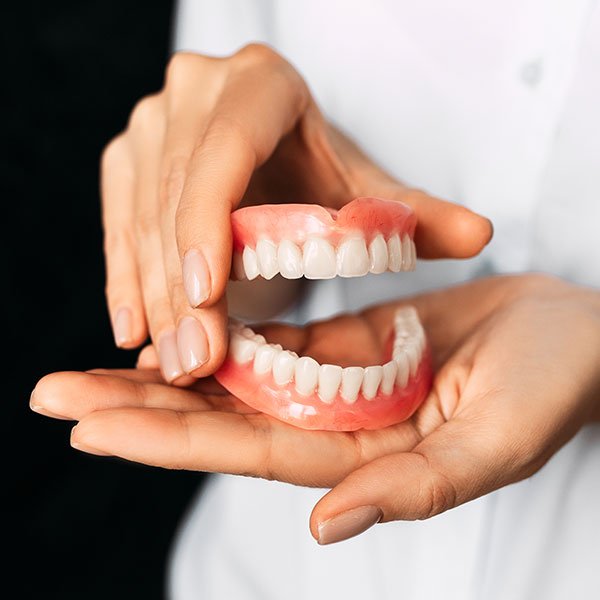
- It may help hold a bridge or denture firmly in place.
In root-filled teeth, it may be necessary to insert a post before placing a crown. A post provides support and helps the crown stay in place. The weakened crown of the tooth may be shortened to gum level. A post can be made of prefabricated stainless steel which the dentist can fit directly into the root canal, or a custom-made post can be constructed by the dental technician to accurately fit the shape of the prepared root canal. The post is placed into the root canal and cemented in position, ready for the crown to be attached.
Bridges
Bridges are only possible if you have strong enough teeth with good bone support. Your dentist will help you decide which is the best way of replacing missing teeth. Bridges are usually made of porcelain bonded to precious metal. Sometimes, there are other non-precious metals used in the base for strength. There are also new bridges made entirely of a special type of strong porcelain.
Why should I replace missing teeth?
Your appearance is one reason. Another is that the gap left by a missing tooth can mean greater strain is put on the teeth at either side. A gap can also mean your ‘bite’ is affected, because the teeth next to the space can lean into the gap and alter the way the upper and lower teeth bite together. This can then lead to food getting packed into the gap, which causes both decay and gum disease.
Implants
A dental implant is a titanium metal rod which is placed into the jawbone. It is used to support one or more false teeth. In practice, both the false teeth and their supporting rod are known as ‘implants’. Implants are a well-established, tried-and-tested treatment. 95% of modern implants should last for many years with the right care. Placing the implants requires a small operation. This can be done using a simple local anaesthetic, and sometimes with sedation if you are very nervous. Sometimes the dentist needs to use a general anaesthetic for complex cases. You will not feel any pain at the time, but you may feel some discomfort during the week after the surgery. This is usually due to having stitches, and the normal healing process.
Cosmetic dentistry
Dentistry is no longer just a case of filling and extracting teeth, as it was for many years. Nowadays, many people turn to cosmetic dentistry, or ‘aesthetic dentistry’, as a way of improving their appearance, much as they would use cosmetic surgery or even a new hairstyle. The treatments can be used to straighten, lighten, reshape and repair teeth. Cosmetic treatments include veneers, crowns, bridges and tooth-coloured fillings.
Tooth whitening
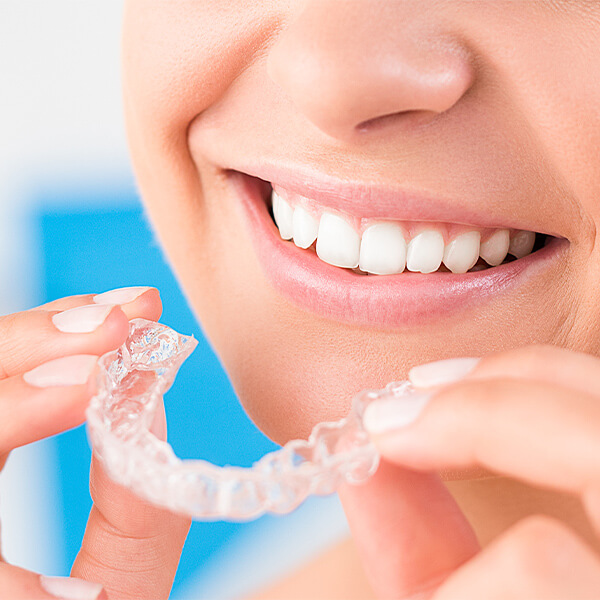
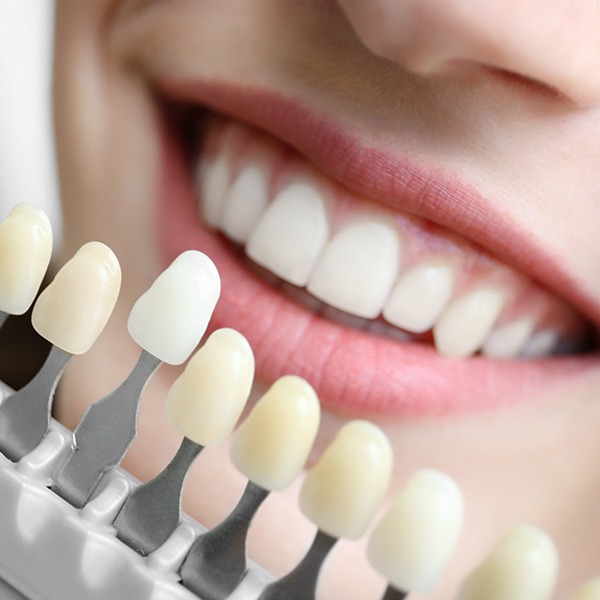
Professional bleaching is the most common form of tooth whitening. Your dentist will apply the whitening product to your teeth, using a specially made tray which fits into your mouth like a gum-shield.The ‘active ingredient’ in the product is usually hydrogen peroxide or carbamide peroxide. As the active ingredient is broken down, oxygen gets into the enamel on the teeth and the tooth colour is made lighter. There is now laser whitening or ‘power whitening’. During this treatment a light or laser is shone on the teeth to activate the chemical. The light speeds up the chemical reaction of the whitening product and the colour change can be achieved more quickly. Laser whitening can make teeth up to five or six shades lighter. This procedure usually takes about one hour.
Veneers
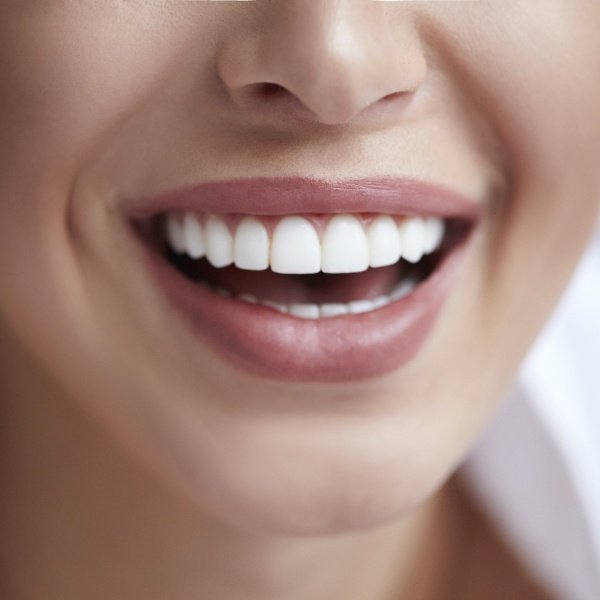
Veneers are thin slices of porcelain. These are precisely made to fit over the visible surface of front teeth, like a false fingernail fits over a nail. Veneers are an ideal way of treating discoloured or unsightly teeth, closing gaps between front teeth, or repairing chips and cracks. They are made by a dental technician, using impressions taken by the dentist. The veneers are made in the laboratory and bonded to the tooth to form a strong and natural-looking repair. Sometimes a natural colour ‘composite’ material is used instead of porcelain. Composite veneers can be completed in one visit and involve bonding tooth-coloured filling material to the front of the tooth. Although these veneers are slightly more prone to staining and have a shorter life, they are easily replaced.
Crowns
When a tooth is badly broken or heavily filled, the dentist may need to crown or ‘cap’ it to restore its appearance and strength. The usual procedure for fitting a crown involves shaping the tooth under local anaesthetic and then taking an impression using a rubber-like material. The impression is then sent to the laboratory, along with the details of the shade to be used, where the technician makes the crown. Crowns can be made of a variety of different materials, such as porcelain or porcelain bonded to gold. New materials are continually being introduced. There are different crowns for certain situations and it is a good idea to discuss with your dentist which crown would be best for you.
Cleaning and prevention
Preventive dentistry is the modern way of reducing the amount of dental treatment necessary to maintain a healthy mouth. It helps you to keep your own teeth. The two major causes of tooth loss are decay and gum disease. The better we prevent or deal with these two problems, the more chance people have of keeping their teeth for life.
The joint efforts of the dentist, the hygienist and the patient can help to prevent the need for treatment, and so avoid the traditional pattern of fillings and extractions. A course of treatment may be recommended to get your mouth into good condition, and a maintenance plan will be worked out to help you keep it that way.
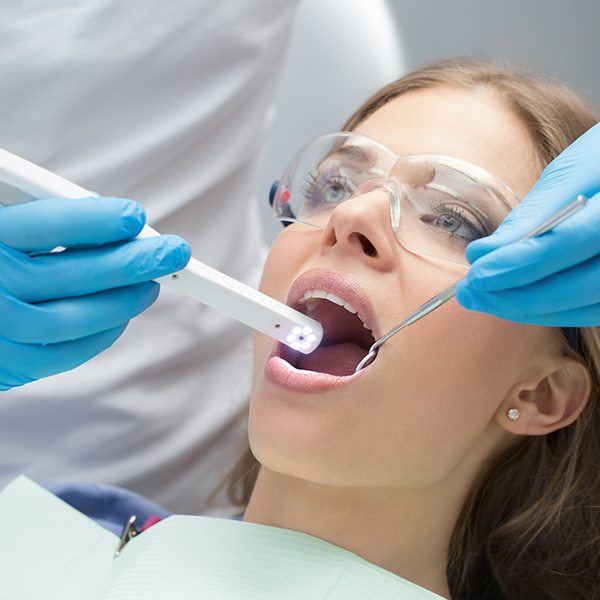
Your dentist will first assess your teeth and gums, and discuss with you any treatment that is necessary. The main aim is to help you get your mouth really healthy and to try and prevent any dental problems returning. In a healthy mouth it is unlikely that decay or gum disease will continue to be a problem.
- The hygienist or dentist will thoroughly ‘scale and polish’ your teeth.
- The dentist or hygienist will show you the best methods of brushing and flossing to remove the bacterial ‘plaque’ which forms constantly on your teeth and gums. Plaque is an invisible film of bacteria that forms constantly on the teeth and gums. When you eat or drink something sugary, the plaque turns the sugar into acid, which will cause tooth decay. Plaque will also cause gum inflammation if it is not regularly and thoroughly removed. The hard tartar (calculus) which builds up on the teeth also starts off as plaque.
- You will be advised which oral care products are the best ones for you to use.
- The hygienist will probably discuss diet and any habits, such as smoking and drinking, with you.
- Your dentist will also make sure that all your fillings are in good repair and there are no rough edges to make cleaning difficult.
Gum disease
Gum disease describes swelling, soreness or infection of the tissues supporting the teeth. There are two main forms of gum disease: gingivitis and periodontal disease. Gingivitis means inflammation of the gums. This is when the gums around the teeth become very red and swollen. Often the swollen gums bleed when they are brushed during cleaning. Long-standing gingivitis can turn into periodontal disease. There are a number of types of periodontal disease and they all affect the tissues supporting the teeth. As the disease gets worse, the bone anchoring the teeth in the jaw is lost, making the teeth loose. If this is not treated, the teeth may eventually fall out. In fact, more teeth are lost through periodontal disease than through tooth decay.
All gum disease is caused by plaque. Plaque is a film of bacteria which forms on the surface of the teeth and gums every day. Many of the bacteria in plaque are completely harmless, but there are some that have been shown to be the main cause of gum disease. To prevent and treat gum disease, you need to make sure you remove all the plaque from your teeth every day. This is done by brushing and flossing.
Opening times
| Mon: | 9.00am - 5.00pm |
| Tue: | 9.00am - 5.00pm |
| Wed: | 9.00am - 5.00pm |
| Thu: | 9.00am - 5.00pm |
| Fri: | 9.00am - 5.00pm |
| Sat: | Closed |
| Sun: | Closed |